Ohio has no mattress recycling law, so there is no free recycling route available to you by right. Your realistic options are your city’s bulk pickup program if it has one, a private hauler, or a trip to the landfill yourself. Which of those works depends entirely on which town you live in, and several Southwest Ohio towns run no program at all.
This is a more complicated question in Ohio than it looks, and most of the advice online is written for states with laws Ohio does not have. What follows is what the statutes, the administrative rules and the cities themselves actually say, including the part almost nobody covers: whether you are allowed to sell or give away a used mattress in Ohio at all.
Jump to the part you need:
- Why there is no recycling program here
- What your city actually does
- Whether you can sell or donate it
- If there are bed bugs
Ohio has no mattress recycling law, and that changes everything
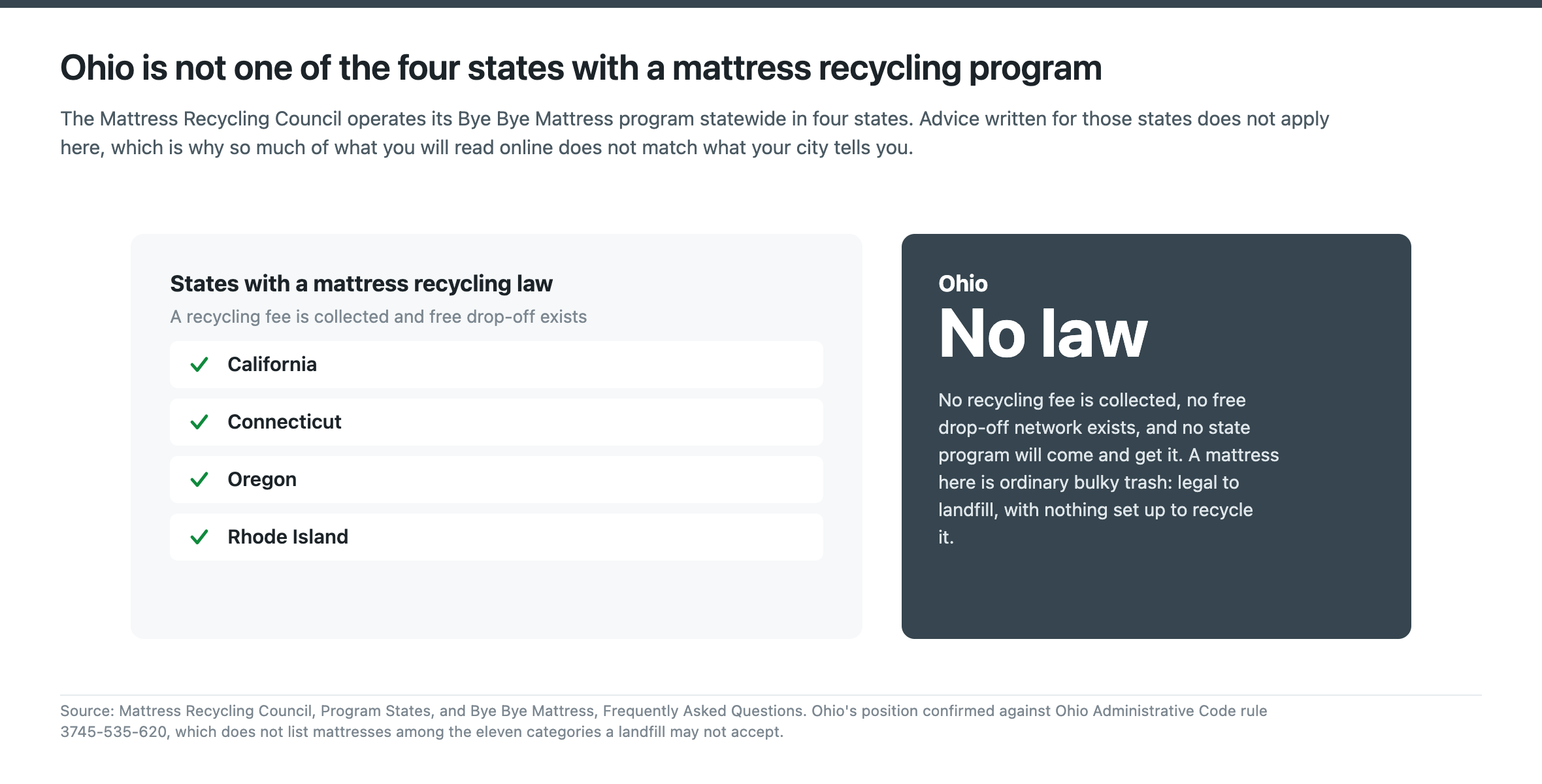
The Mattress Recycling Council is the non-profit that operates Bye Bye Mattress, the recycling program most articles about mattress disposal describe. On its own website the Council states that it operates statewide in California, Connecticut, Oregon and Rhode Island, and its program FAQ says the program “is only available to consumers (individuals and businesses) based in California, Oregon, Connecticut and Rhode Island.”
Ohio is not on that list. There is no recycling fee collected here, no free drop-off network, and no state-funded collection.
The other half of the picture is that Ohio does not ban mattresses either. Ohio Administrative Code rule 3745-535-620, the disposal restrictions rule that governs what a municipal solid waste landfill may not accept, lists eleven prohibited categories: asbestos, liquids, hazardous waste, PCB waste, infectious waste, source-separated yard waste, scrap tires, low-level radioactive waste, semi-solid material with free liquids, TENORM, and secondary aluminum waste. Mattresses are not among them, and neither are bulky household items generally.
So in Ohio a mattress is ordinary bulky trash. It is legal to landfill and there is nothing set up to recycle it. Ohio EPA’s own materials and waste management FAQ pushes the question back down to the local level, stating that “your local solid waste management district is your first source of disposal and recycling information.”
That is worth sitting with, because it explains why the advice you find is so inconsistent. There is no statewide answer. There are dozens of local ones.
What the local districts publish
The Ross-Pickaway-Highland-Fayette district, which covers Highland, Fayette and Ross counties, publishes recycling drop-off locations across Hillsboro, Greenfield, Leesburg, Lynchburg and Rainsboro, but its miscellaneous disposal options page names no mattress, furniture or bulky item guidance at all. For appliances it advises residents to check with their municipality for large item pickup days. Clinton County’s recycling resources list has no mattress entry either. Clermont County’s large item page says plainly that your regular trash collection provider will pick up large items for a fee, that costs vary widely by region, and that you should call your provider for the cost and restrictions in your area.
Elsewhere in Ohio a district has stated the position more directly. Cuyahoga County’s solid waste district tells residents outright that “there are no local recycling options for mattresses” and points them to donation, retailer haul-away, municipal bulky waste pickup, or a transfer station. That is an Ohio government source saying plainly what the districts in this region leave unsaid.
What your city actually does
This is the part that decides your answer, and it varies more than most people expect between towns twenty minutes apart.
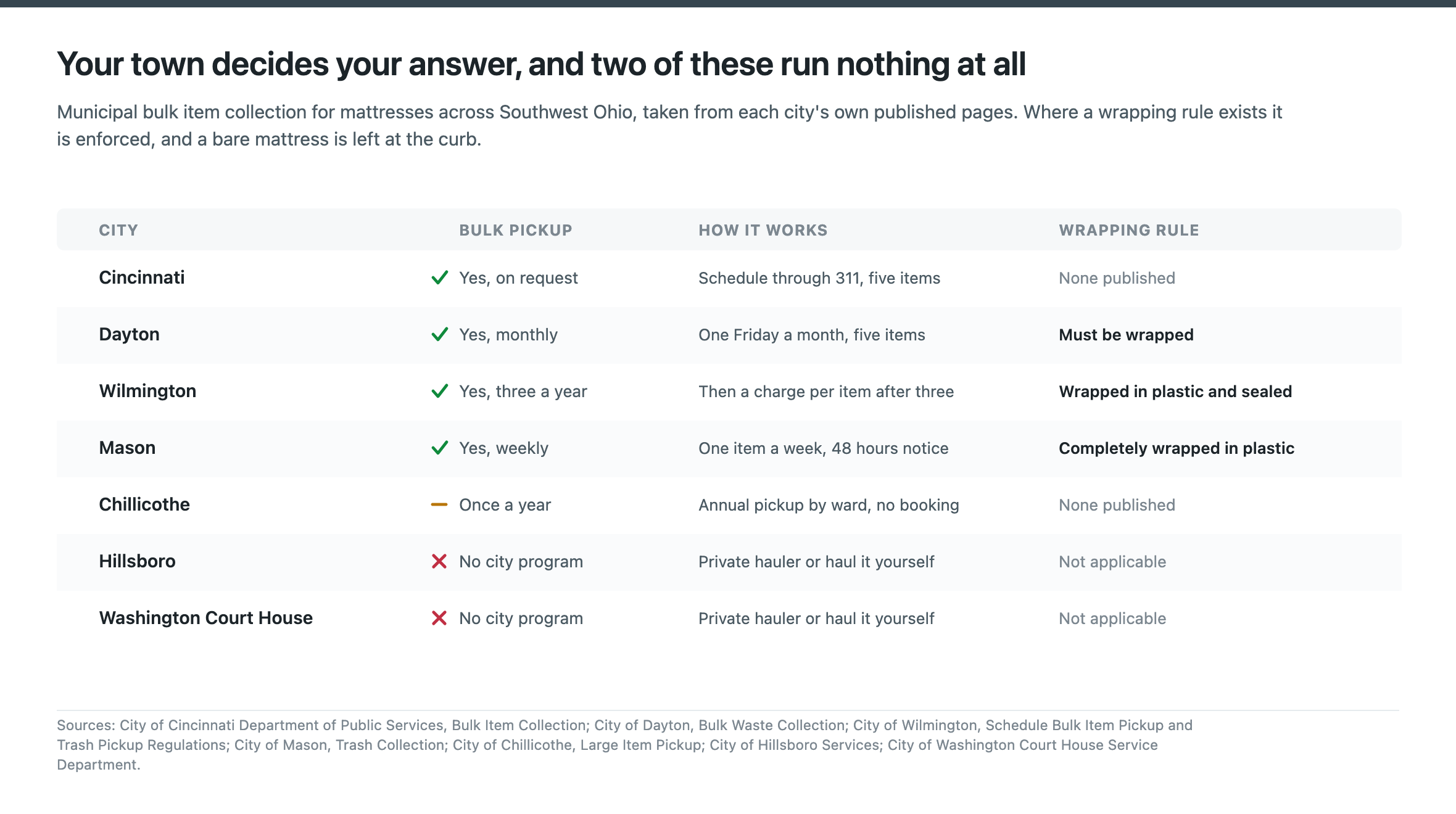
| City | Bulk pickup? | How it works | Preparation required |
|---|---|---|---|
| Cincinnati | Yes | Schedule through 311. Mattress and box spring are listed acceptable items. Up to five bulk items per household per appointment. | No wrapping requirement published. Items out the night before, at the curb, clear of obstructions. |
| Dayton | Yes | One Friday each month. Schedule in advance by phone or through the city portal. Limited to five large items or up to 25 bags or boxes. | Mattresses and box springs “must be wrapped.” The city does not specify in what. |
| Wilmington | Yes | Three bulk items per year included, then a charge of $15 per item. A mattress and box spring set counts as one item. Picked up on the next regular collection day. | Mattresses and upholstered furniture must be wrapped in plastic and sealed. |
| Mason | Yes | One large item per week, arranged at least 48 hours in advance through Mason Utility Customer Service. Collected by the city’s contracted hauler. | Mattresses, box springs and upholstered furniture must be completely wrapped in plastic. |
| Chillicothe | Once a year | An annual large item pickup by ward, beginning the week of May 26 in 2026. No appointment needed. Mattresses are named as an accepted item. | Kept separate from regular trash and placed at the curb, not in alleys or on private property. |
| Hillsboro | No | The city publishes a yard waste facility and a leaf pickup program, and no refuse or bulk item service. Residents contract with private haulers. | Not applicable. |
| Washington Court House | No | The city’s service department page lists brush chipping, leaf collection and wastewater only. No bulk item program is published. | Not applicable. |
Two things stand out. First, two of the region’s larger towns run nothing at all. If you live in Hillsboro or Washington Court House, there is no city truck coming for it, which is why a hauler is the normal answer there rather than a fallback.
Second, the wrapping requirement is not a formality. Mason says completely wrapped in plastic. Wilmington says wrapped in plastic and sealed. Dayton says wrapped. A mattress left bare at the curb in those cities does not get taken, and the crew is not coming back for it. Buy a mattress bag before the collection day, not after.
City programs change, and limits, fees and set-out rules get revised without much notice. Whatever your town, confirm the current rule with the city before you plan around it. If you are in Middletown or another city not listed above, the city’s own sanitation page is the place to check.
Can you sell or donate a used mattress in Ohio?
This is the most searched question attached to this topic and it has a real statutory answer, which is why so many people are surprised when the charity turns them away.
Ohio Revised Code Chapter 3713 is titled “Bedding and Stuffed Toys,” and section 3713.03 places it under the superintendent of industrial compliance in the Ohio Department of Commerce. Section 3713.01 defines bedding to include “any mattress, upholstered spring, comforter, bolster, pad, cushion, pillow, mattress protector, quilt, and any other upholstered article, to be used for sleeping, resting, or reclining purposes.” Secondhand means any article of which prior use has been made in any manner whatsoever.
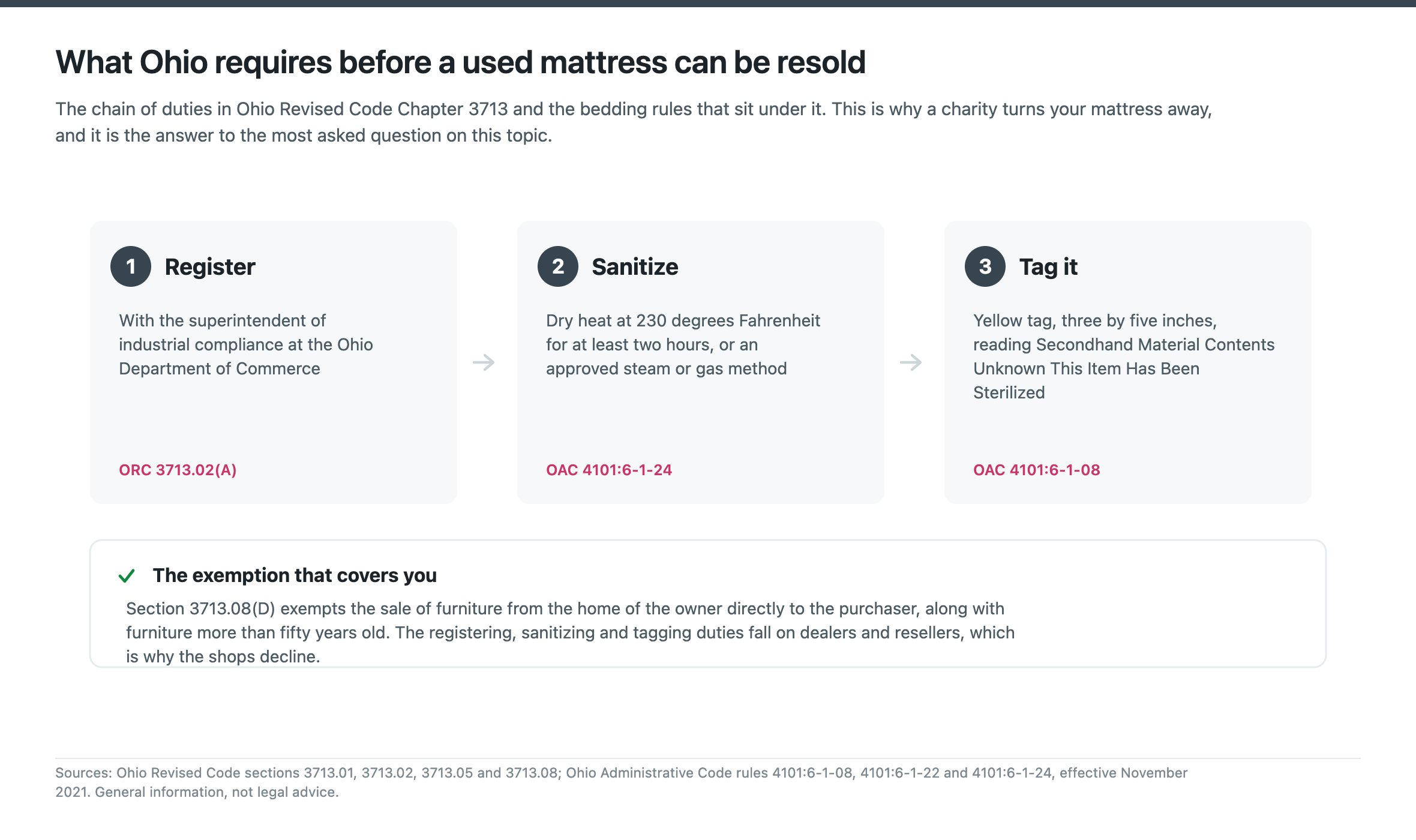
Two requirements follow. Section 3713.02(A) states that, except as provided in section 3713.05, no person shall “sell or offer for sale any second-hand article of bedding” in Ohio “without first registering to do so with the superintendent of industrial compliance.” Section 3713.02(D) states that no person shall “sell or offer for sale any secondhand article of bedding or any secondhand stuffed toy that has not been sanitized in accordance with section 3713.08.”
What sanitizing actually means
The administrative rules put numbers on it. Ohio Administrative Code rule 4101:6-1-24, effective November 2021, sets out the approved sterilization methods. Dry heat requires “a maintained temperature of two hundred thirty degrees Fahrenheit for a minimum period of two hours.” Steam requires 15 pounds per square inch at 250 degrees for thirty minutes, or 20 pounds at 260 degrees for twenty minutes. There is also an approved carbon dioxide method and an approved spray process.
Rule 4101:6-1-08 then requires the item to carry a yellow tag with black printing, at least three inches by five, with type at least a quarter inch high, reading “Secondhand Material Contents Unknown This Item Has Been Sterilized” along with a registration number. Original tags must be removed and the new label attached securely and visibly before sale.
Rule 4101:6-1-22 adds that secondhand bedding intended for resale or lease must be sanitized or sterilized, and prohibits material containing “bugs, vermin, insects, or filth.”
That is a commercial-grade process requiring equipment no household and very few thrift stores own. It is the reason a used mattress is close to worthless in the resale market here, and it is the reason the answer at the donation door is almost always no.
The exemption that applies to you
Section 3713.08(D) exempts three things from the sanitizing and labeling section: persons meeting the qualifications of divisions (C)(2) or (3) of section 3713.05, the sale of furniture more than fifty years old, and “the sale of furniture from the home of the owner directly to the purchaser.”
That third one is the carve-out for an ordinary person selling their own mattress out of their own house. The chapter is written to regulate dealers, renovators, importers and wholesalers, and section 3713.02(E) keys its evidentiary presumption to possession “in the course of business by a person required to obtain registration.” Giving a mattress away for nothing also sits outside the chapter’s definition of “sell,” which covers selling, offering to sell, delivering or consigning in sale, or possessing with intent to sell.
What this does not mean is that a resale shop can take it off your hands casually. The duty to sanitize, tag and register falls on whoever resells it, which is precisely why the shops decline.
This section describes what Ohio statutes and administrative rules say. It is general information, not legal advice. The Ohio Department of Commerce Division of Industrial Compliance administers Chapter 3713 and is the right place to direct a specific question.
Why the charities say no
People are often surprised by this, so here is what the organizations publish themselves.
Habitat for Humanity ReStore. Habitat for Humanity International’s national donation guidance states that “mattresses and box springs are not accepted.” Habitat for Humanity of Greater Cincinnati says the same in its own local donation guide.
Goodwill. Ohio Valley Goodwill in Cincinnati lists what it accepts and then states that it “cannot accept hazardous materials, mattresses, large appliances, weapons, or items in poor condition due to safety and resale limitations.”
St. Vincent de Paul, Cincinnati. Its accepted items list includes clean usable furniture, sheets and blankets, and small appliances. Mattresses and box springs are not on it. Notably, the organization’s Bed Program distributes new bed frames, mattresses and mattress covers at no cost to families, which is a much better thing to point a neighbour in need toward than a used mattress.
The Salvation Army. This is the one exception worth checking. The national thrift store FAQ does list mattresses among accepted unbroken furniture. But individual centers set their own rules and the resale duties under Chapter 3713 fall on the store, so call your local location before loading anything into a truck.
If you have a mattress in genuinely good condition and want it to go to use rather than a landfill, calling around is worth an afternoon. If it is stained, sagging, older than about eight years, or has been in a rental turnover, the honest answer is that no one wants it and the sooner you accept that the less time you spend driving it around.
If there are bed bugs
Different problem, different rules, and getting it wrong spreads an infestation through a building.
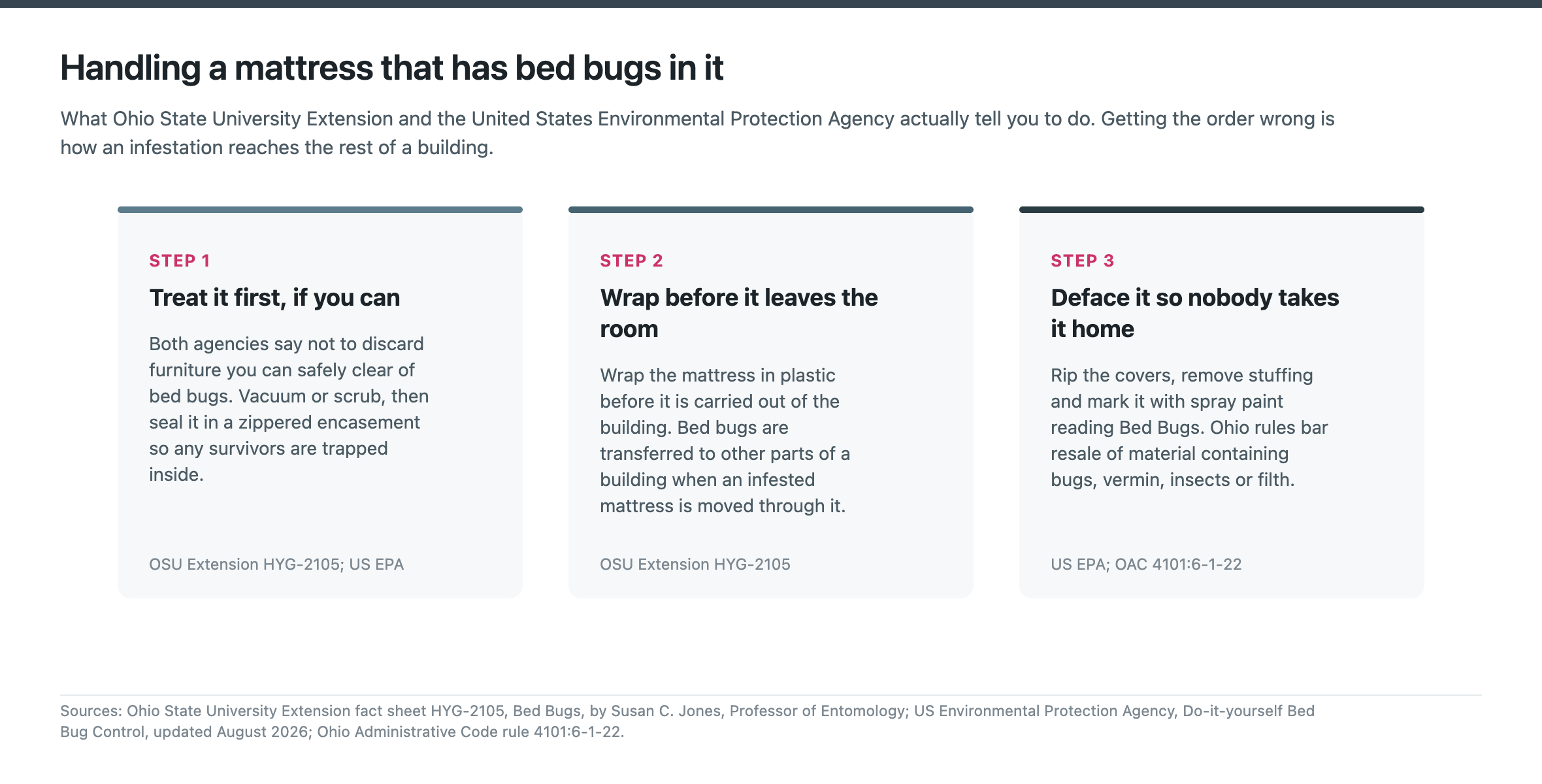
Ohio State University Extension’s bed bug fact sheet, written by Susan C. Jones, Professor of Entomology, is the authority most commonly used in Ohio. It advises that a mattress being discarded “should be done so only after being treated,” and that it should be “wrapped in plastic before being taken out of the building and defaced/destroyed so that it is not reused.” The reason for the wrapping is stated directly: bed bugs can be transferred to other parts of the building when moving the mattress.
The United States Environmental Protection Agency’s guidance on do-it-yourself bed bug control, last updated in August 2026, adds the destruction step in more detail. It advises ripping covers and removing stuffing from furniture items, using spray paint to mark furniture with “Bed Bugs,” and having infested items picked up as soon as possible by the trash collection agency. It also says not to discard furniture if you can safely eliminate the bed bugs from it, because replacing everything is expensive and often unnecessary.
Both agencies also cover encasements. OSU Extension notes that after a mattress is vacuumed or scrubbed it can be enclosed in a zippered encasement that traps any remaining bugs inside, and EPA describes sealed covers as a way to trap bed bugs so they die. If the mattress can be saved that way, saving it is the better outcome.
One legal note that ties back to the section above: Ohio Administrative Code 4101:6-1-22 prohibits resale material containing bugs, vermin, insects or filth. An infested mattress cannot lawfully go back into commerce in Ohio, which is exactly why Extension tells you to deface it rather than leave it whole at the curb where someone will take it home.
What is inside a mattress, and what recycling would recover
The Mattress Recycling Council’s own deconstruction study, published in December 2021, measured composition by weight across bonnell spring, all-foam and pocket coil mattresses, and separately for wood and wood-and-metal foundations. One finding worth knowing: the wood in a bed set comes from the foundation or box spring, not from the mattress itself.
The Council’s published milestone figures give a sense of the scale. When Bye Bye Mattress recycled its millionth mattress, announced in January 2017, the Council reported diverting nearly 25,000 tons of material and more than 11 million cubic feet of landfill space, recovering steel, foam, fibres and wood.
The frustrating part for an Ohio reader is that all of that is real and none of it is available here by right. Mattress recycling in this region runs through private businesses rather than any public program, and no Southwest Ohio solid waste district names a mattress recycler in its published guidance. That is not a reason to feel bad about landfilling a mattress. It is a description of the infrastructure that exists. The same gap is why an old appliance or a rolled-up carpet ends up in the same conversation.
Common questions
Can you sell a used mattress in Ohio?
Ohio Revised Code 3713.02 requires anyone selling or offering to sell secondhand bedding to register with the superintendent of industrial compliance and to have the item sanitized under section 3713.08. Section 3713.08(D)(3) exempts “the sale of furniture from the home of the owner directly to the purchaser,” which is the provision covering an ordinary homeowner selling their own mattress out of their own home. The registering, sanitizing and tagging duties fall on dealers and resellers, which is why shops decline used mattresses. For a specific situation, the Ohio Department of Commerce Division of Industrial Compliance is the authority.
Can a mattress go in a landfill in Ohio?
Yes. Ohio Administrative Code 3745-535-620 lists eleven categories a solid waste landfill may not accept, and mattresses are not among them. Ohio has no mattress landfill ban and no mattress recycling law. Whether your local transfer station or landfill charges a separate per-item fee is a local question, so call ahead.
Does a mattress have to be wrapped for curbside pickup?
It depends on the city. Mason requires mattresses, box springs and upholstered furniture to be completely wrapped in plastic. Wilmington requires them wrapped in plastic and sealed. Dayton says they must be wrapped without specifying the material. Cincinnati and Chillicothe publish no wrapping requirement for mattresses. Where wrapping is required it is enforced, so a bare mattress will be left behind.
Do a mattress and box spring count as one item or two?
Wilmington states explicitly that a mattress and box spring set counts as one bulk pickup. Other cities in the region do not publish an answer, and Cincinnati’s five item limit and Dayton’s five item limit are written per item rather than per set. If you are close to a city’s limit, ask when you schedule rather than assuming.
Who picks up a mattress in Hillsboro or Washington Court House?
Neither city runs a bulk item program, so the options are a private hauler, your own trip to a transfer station, or your regular trash provider if they offer large item service. In practice that usually means one visit that takes the mattress along with whatever else is going.
The short version
If your city runs a bulk program, use it and follow the wrapping rule exactly. If it does not, or if the mattress is one item in a larger clear-out, a hauler is simpler than three trips and a rented truck.
Larry’s Junk Removal handles mattresses as part of furniture removal across Highland, Clinton, Fayette, Ross and Hamilton counties, into Northern Kentucky, and throughout the rest of the service area. A mattress comes out along with everything else on a full cleanout or an estate cleanout, so a bed set plus a couch plus whatever else has accumulated is one visit rather than five decisions. The items we take page lists what goes on the truck, and you can reach us through contact us.
Sources
- Mattress Recycling Council, Program States, and Bye Bye Mattress, Frequently Asked Questions
- Mattress Recycling Council, Composition Analysis Study Report, December 2021
- Mattress Recycling Council, MRC Marks Millionth Mattress Milestone, January 2017
- Ohio Administrative Code, Rule 3745-535-620, Disposal restrictions, effective June 2024
- Ohio Revised Code, Chapter 3713, Bedding and Stuffed Toys, including 3713.02 and 3713.08
- Ohio Administrative Code, Rule 4101:6-1-24, Methods of sterilization, Rule 4101:6-1-08, Label requirements, and Rule 4101:6-1-22, Materials required to be sterilized
- Ohio Department of Commerce, Division of Industrial Compliance, Bedding, Stuffed Toys and Upholstery
- Ohio EPA, Division of Materials and Waste Management, Frequently Asked Questions
- Cuyahoga County Solid Waste District, Mattresses
- City of Cincinnati Department of Public Services, Bulk Item Collection
- City of Dayton, Bulk Waste Collection
- City of Wilmington, Schedule Bulk Item Pickup and Trash Pickup Regulations
- City of Mason, Trash Collection
- City of Chillicothe, Large Item Pickup
- Ohio State University Extension, Bed Bugs, fact sheet HYG-2105, Susan C. Jones
- United States Environmental Protection Agency, Do-it-yourself Bed Bug Control, updated August 2026
- Habitat for Humanity International, Should I donate this to the Habitat ReStore?
- Ohio Valley Goodwill, Donation Options
- St. Vincent de Paul Cincinnati, What to Donate