
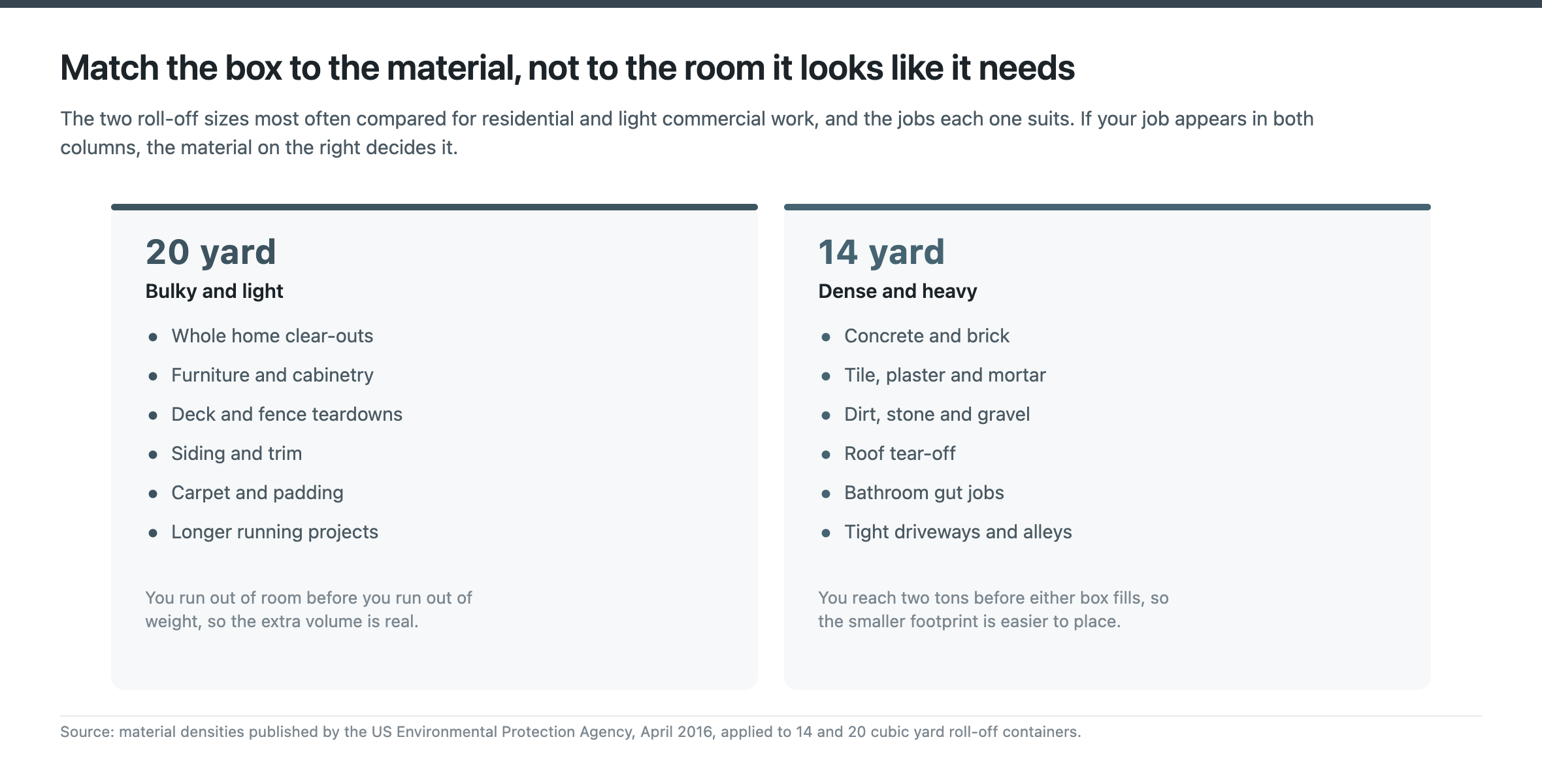
A 14 yard and a 20 yard roll-off normally carry the same weight allowance, commonly two tons, so choosing between them is a question about volume, not weight. Pick the 20 yard when the material is bulky and light. Pick the 14 yard when it is heavy and dense, because dense debris hits the weight ceiling long before it fills either box.
Every dumpster size guide online answers the same question: how much stuff fits. That is the easy half. The half that decides whether your rental goes smoothly is the one almost nobody publishes, and it is this: for a large share of the jobs people rent a container for, the box will never fill up. It will get heavy first.
This guide walks through both halves using published federal and state data rather than rules of thumb, and it compares two real sizes rather than a hypothetical lineup of five. If you want the short version, skip to picking by project.
The two boxes, and the thing they have in common
The two sizes most often compared for residential and light commercial work are the 14 cubic yard container and the 20 cubic yard container. On roll-off rentals in this size range, both typically come with the same included weight allowance of two tons.
That shared allowance is the single most important fact on this page, and it is worth stating plainly. The 20 yard box does not come with more weight. It comes with more room. If you fill a 20 yard container with something heavy, you reach the same 4,000 pound ceiling you would have reached in the 14 yard, just with more empty space above the load.
So the decision splits cleanly:
- Bulky and light material, where you will run out of room before you run out of weight. Furniture, cabinets, decking, drywall, brush, general household clear-outs. Here the bigger box genuinely buys you something.
- Dense material, where you will hit two tons well before the box looks full. Concrete, brick, dirt, roofing tear-off, tile, plaster. Here the bigger box buys you almost nothing, and the real conversation is about a fill line rather than a size.
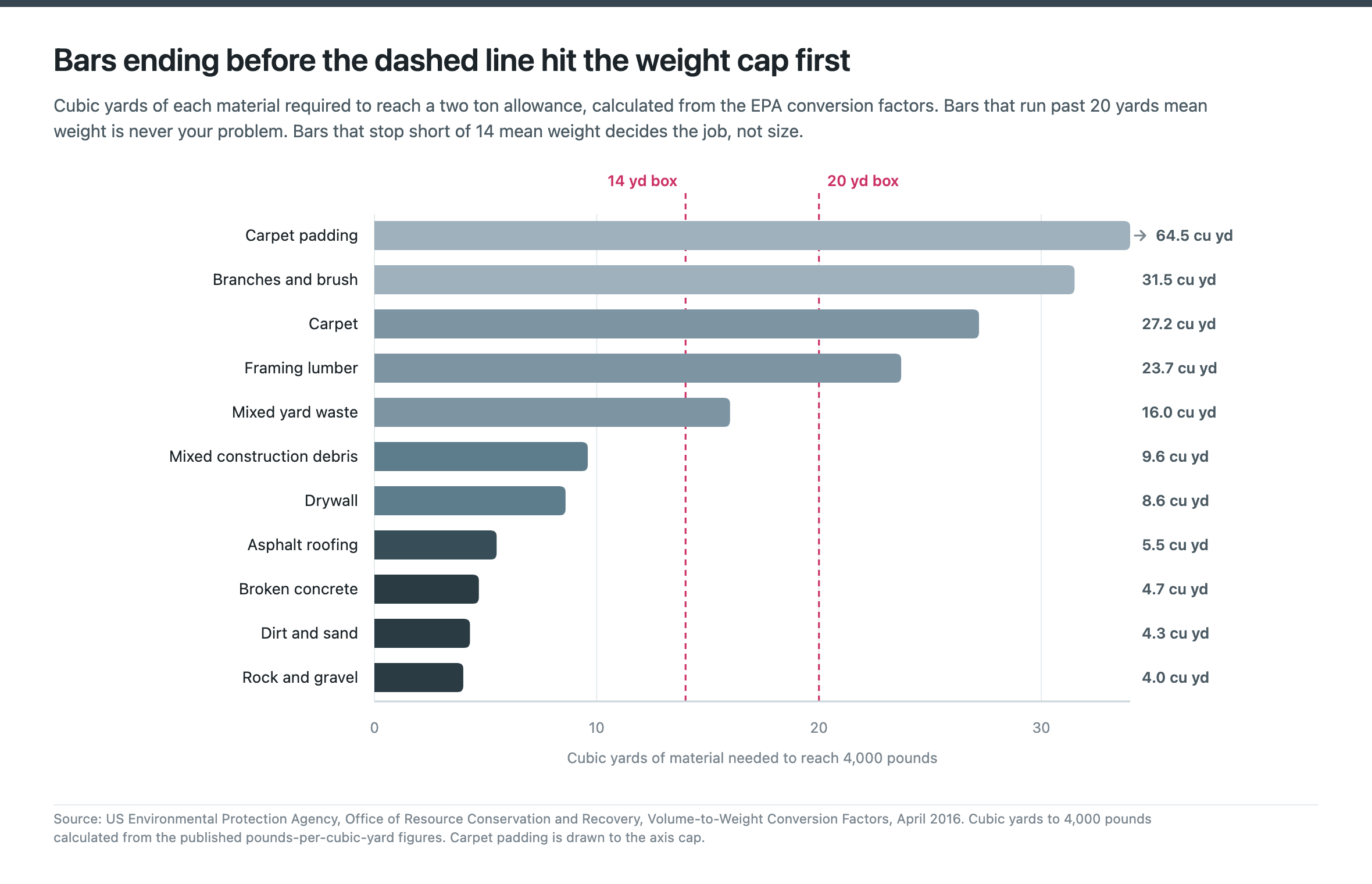
How much of each material makes two tons
The United States Environmental Protection Agency publishes conversion factors that turn a volume of waste into a weight. The current document, Volume-to-Weight Conversion Factors, was issued by EPA’s Office of Resource Conservation and Recovery in April 2016 and gives a pounds-per-cubic-yard figure for most of what ends up in a construction container.
Run those numbers against a 4,000 pound allowance and the picture changes fast.
| Material | Pounds per cubic yard (EPA, 2016) | Cubic yards to reach two tons |
|---|---|---|
| Carpet padding | 62 | 64.5 |
| Branches, brush and prunings | 127 | 31.5 |
| Carpet | 147 | 27.2 |
| Dimensional lumber and framing wood | 169 | 23.7 |
| Mixed yard waste, uncompacted | 250 | 16.0 |
| Mixed construction and demolition debris | 417 | 9.6 |
| Drywall and gypsum board | 467 | 8.6 |
| Asphalt roofing and composition shingles | 731 | 5.5 |
| Asphalt paving | 773 | 5.2 |
| Broken concrete, loose in a container | 860 | 4.7 |
| Dirt and sand | 929 | 4.3 |
| Rock and gravel | 999 | 4.0 |
Read the right-hand column against the box sizes. Carpet padding would need more than sixty cubic yards to reach two tons, which is three full 20 yard containers, so weight is irrelevant to that job. Rock reaches two tons in four cubic yards, which is one fifth of a 20 yard box.
The materials that sit at the top of that list are the ones where a 20 yard container is worth renting. The ones at the bottom are the ones where the box size barely matters, because you will be told to stop filling long before the walls are reached.
The mixed load is the case most people are actually in
Most residential jobs are not one material. They are a mix, and the mix has been measured. Researchers at the University of Florida weighed 171 separate loads of construction and demolition debris across ten facilities and published an average bulk density of 484 pounds per cubic yard, roughly 0.24 tons per cubic yard. EPA carries that same figure in its 2016 memorandum under the heading “Construction and Demolition Bulk.”
Apply it:
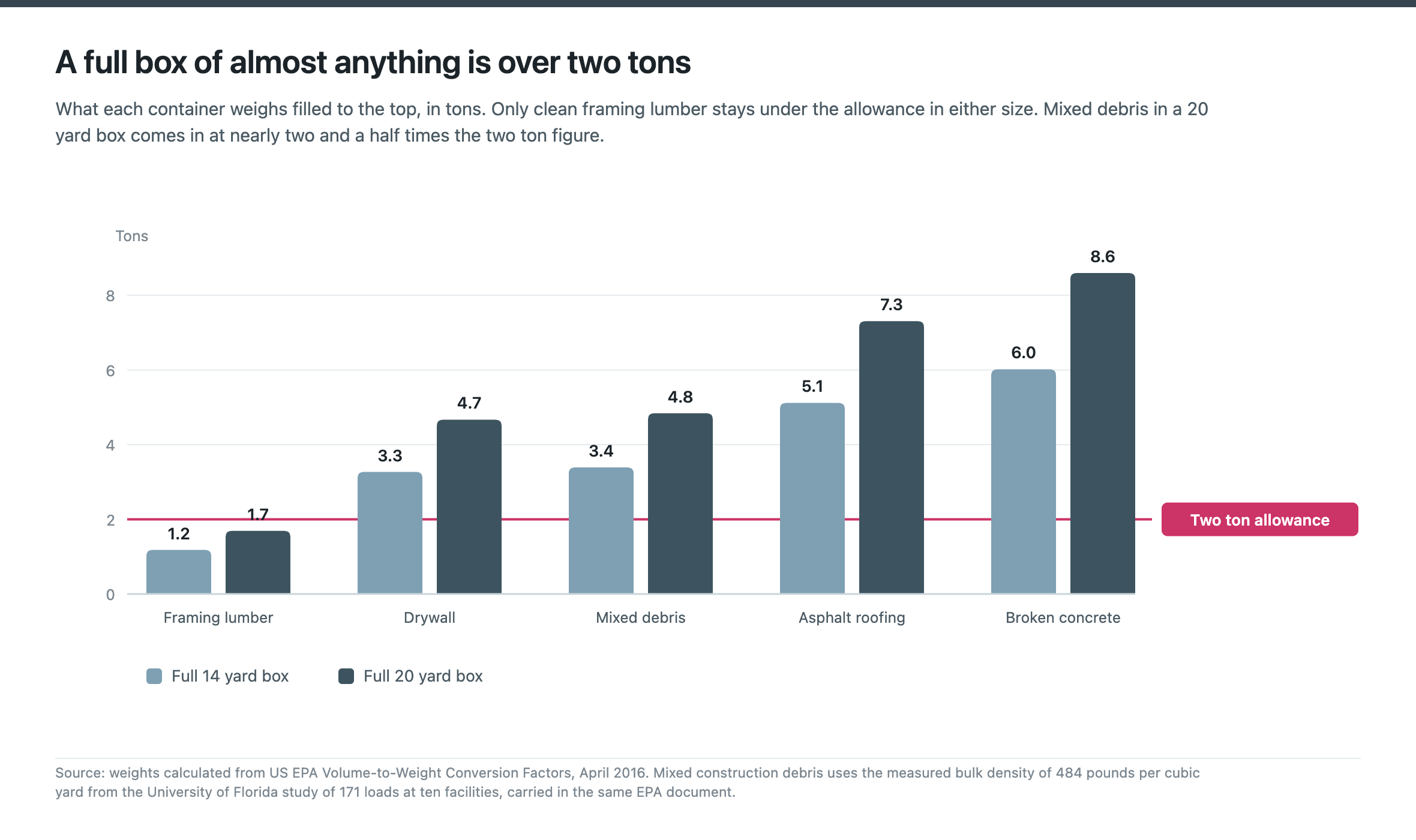
- A 14 yard box filled to the top with mixed debris weighs about 6,776 pounds, or 3.4 tons.
- A 20 yard box filled to the top with mixed debris weighs about 9,680 pounds, or 4.8 tons.
Both are over a two ton allowance. The 20 yard is nearly two and a half times over it. That is not a warning about any one container, it is arithmetic that applies to any roll-off box anywhere, and it explains something homeowners find genuinely surprising: a container you filled honestly, with nothing unusual in it, can still come in heavy.
Three materials that will surprise you
Solid concrete. The Washington State Department of Transportation publishes a unit weight for plain structural concrete of 150 pounds per cubic foot, and 155 for reinforced. At 27 cubic feet to the yard, that is 4,050 pounds per cubic yard. One cubic yard of intact concrete is a two ton load on its own. A patio slab of any size needs to be discussed before it is broken up, not after.
Wet clay soil. EPA’s older Standard Volume-to-Weight Conversion Factors table lists dry common earth at 70 to 80 pounds per cubic foot and wet earth containing clay at 100 to 110. Converted, wet clay runs 2,700 to 2,970 pounds per cubic yard against 1,890 to 2,160 for dry. Southwest Ohio is clay country, and rain changes the number. Under a cubic yard and a half of wet clay is two tons.
Roof tear-off. The National Institute of Standards and Technology, in its Building for Environmental and Economic Sustainability product data, gives the average weight of asphalt shingles as 14 kilograms per square meter, which it states as 280 pounds per roofing square of 100 square feet. That works out to roughly 1,430 square feet of single-layer roof to reach two tons. A second layer doubles it. Anyone tearing off a full roof should plan the weight before the size.
Picking by project
Here is how the two sizes map onto the jobs that come up most often in Highland, Clinton, Fayette and Ross counties.
Choose the 14 yard when
- The material is dense. Concrete, brick, tile, dirt, stone, plaster, roofing. You will hit the ceiling first regardless, so the smaller footprint is easier to place and easier to work around.
- Access is tight. Shorter driveways, narrow alleys, tree cover, a turnaround that a longer container makes awkward.
- The job is one room. A bathroom gut, a single-room renovation, a garage clear-out, a moderate amount of construction debris all sit comfortably inside a 14 yard roll-off container.
Choose the 20 yard when
- The material is bulky and light. Whole-home clear-outs, furniture, cabinetry, decking, siding, carpet and padding pulled out together.
- You are removing a structure made of wood. Deck teardowns, fencing, sheds. EPA puts framing lumber at 169 pounds per cubic yard, so a full 20 yard box of clean lumber is only about 1.7 tons and comfortably inside the allowance.
- You are running a longer project and want to avoid a second haul. Major renovations, flooring pulls, ongoing construction work.
When neither is the right answer
Sometimes a container is the wrong tool. If the material is heavy and the volume is small, a single crew visit is simpler than a box sitting in your driveway for a week. If you are clearing an entire property and do not want to touch any of it yourself, a full cleanout or an estate cleanout is loaded and hauled by a crew rather than by you. If it is one heavy item, the item-specific services do it in one trip: a piano, a pool table, a treadmill or weight rack, a trampoline. The full-service junk removal page covers how that works, and items we take lists what goes on the truck.
Making it fit on your property
There is no government standard for the outside dimensions of a roll-off container, so treat any published dimension chart as that company describing its own equipment. What is published, and what matters more, is the space the truck needs.
The University of North Carolina at Chapel Hill’s Facilities Services design guidelines specify roll-off service vehicle requirements for site planning. They list a roll-off truck at 34 feet 9 inches long and 11 feet wide including mirrors, a 65 foot turning radius, containers of 21 to 23 feet, a combined length of roughly 52 feet while a container is being lifted, and overhead clearance of 18 to 24 feet.
That last figure is the one that catches people. The container is not tall, but the truck’s hoist arm rises well above it during the drop and the pickup. Low branches, carport roofs, second-storey eaves and utility drops across a driveway all sit inside that envelope. It is worth walking the placement and looking up before delivery day rather than on the morning of.
Two other placement notes. Put down plywood if you are protecting a decorative or newly sealed driveway surface, and flag it in advance if the driveway has a septic tank, leach field or cistern under it. Driveway conditions vary a great deal across Hillsboro, Wilmington, Washington Court House, Mason, Greenfield and the rest of Southwest Ohio, from long gravel runs to short city driveways with a tight turn.
What Ohio will not let you put in it
This section is the one worth reading twice, because the penalty is severe and most people have never heard it.
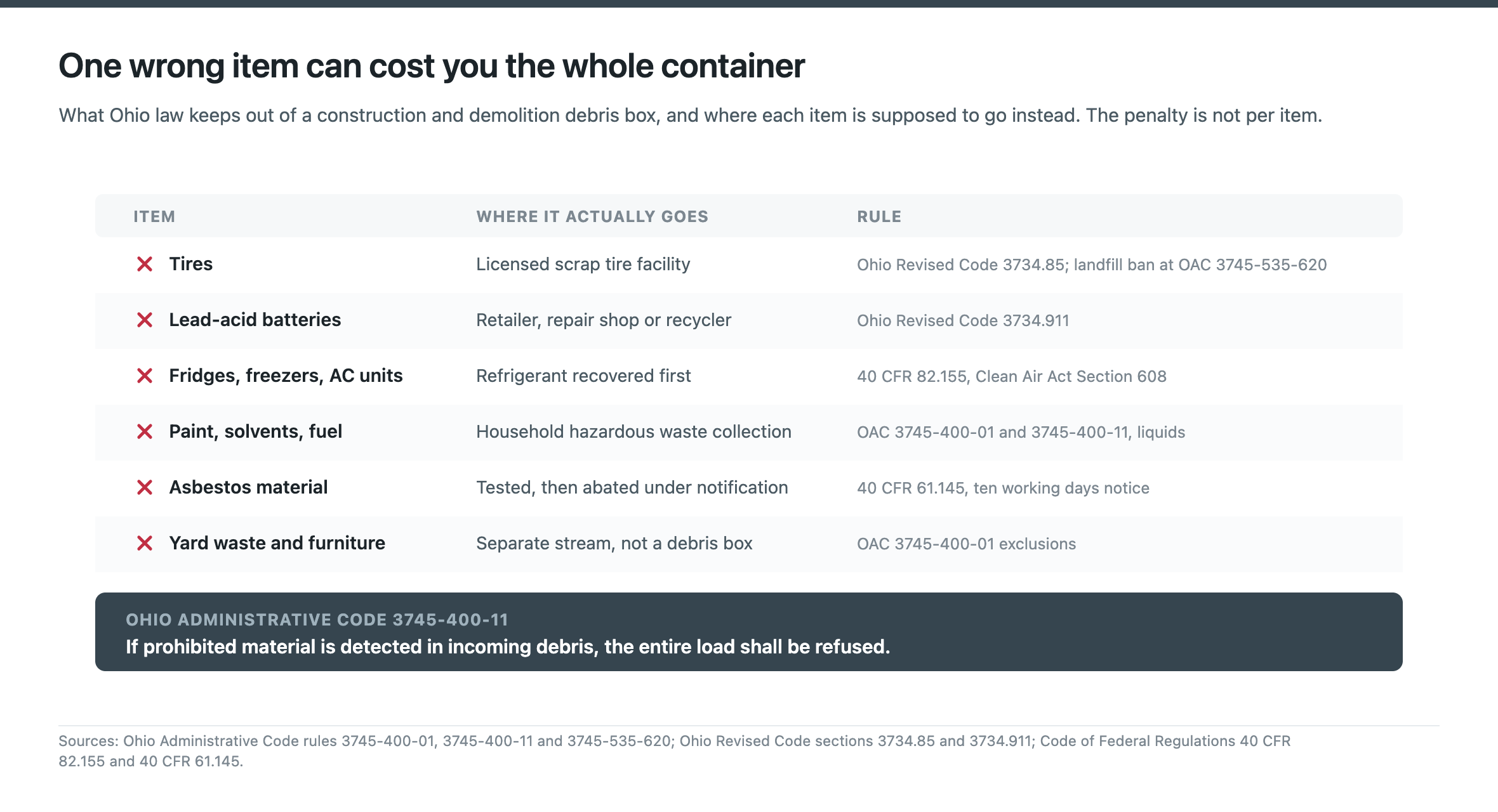
Ohio Administrative Code rule 3745-400-01 defines construction and demolition debris and specifically excludes liquids, containerized items, fuel tanks, drums, tires, batteries, yard wastes, furniture and appliances. Rule 3745-400-11, which governs how those facilities operate, states that a facility owner or operator shall not accept hazardous waste, infectious waste, or containerized or bulk liquids, and then adds the sentence that matters to you:
“If any such prohibited materials are detected in incoming debris, the entire load shall be refused.”
Not the item. The load. A single car battery buried under a ton of drywall can send the whole container back, and the cost of that lands on whoever rented the box.
The specific items, and where they actually go
Tires. Ohio Administrative Code 3745-535-620 prohibits whole or shredded scrap tires at solid waste landfills, with narrow exceptions. Ohio Revised Code 3734.85 requires scrap tires to go to a licensed scrap tire storage, monocell, monofill or recovery facility. Section 3734.83 exempts a person transporting ten or fewer scrap tires in a single load from registering as a scrap tire transporter, which is the provision that lets a homeowner haul a few tires themselves. They move through a separate tire removal stream instead.
Lead-acid batteries. Ohio Revised Code 3734.911 states that no person shall commingle a used lead-acid battery with solid waste or dispose of one at a solid waste or hazardous waste facility. They go back to a retailer, a wholesaler, an automotive repair business, a household hazardous waste collection or a compliant recycler.
Anything with refrigerant. Refrigerators, freezers, window air conditioners and dehumidifiers are governed federally under Section 608 of the Clean Air Act. The rule at 40 CFR 82.155 makes the final person in the disposal chain responsible for recovering the refrigerant or verifying, through a signed statement or contract naming who recovered it and when, that it has already been recovered. That paperwork is why appliances go through appliance removal rather than into a debris box.
Asbestos. Older Highland and Ross county housing stock is exactly where this comes up. The federal asbestos rules at 40 CFR 61.145 require notification at least ten working days before asbestos stripping or removal begins, and also before a demolition even where no regulated asbestos-containing material is present. The regulated thresholds are 260 linear feet on pipes, 160 square feet on other components, or 35 cubic feet where length and area cannot be measured. If you suspect asbestos in floor tile, pipe wrap or siding, stop and get it tested before anything is broken up.
Paint, solvents and fuel. Ohio’s rules do not publish a named list of these, but they are covered squarely by the liquids provisions. Rule 3745-400-01 excludes liquids and containerized items from construction and demolition debris, rule 3745-400-11 bars containerized or bulk liquids from the facility, and rule 3745-535-620 bars containerized bulk liquids and non-containerized liquids from landfills, excepting small household-size containers. Dried-out paint cans are a different case from full ones. If in doubt, set them aside and ask.
Electronics and televisions. Not banned in the same way, but they belong in a recycling stream rather than a debris box. See e-waste removal and television removal.
Street placement and permits
If the container goes on your own driveway or your own property, no Southwest Ohio city publishes a permit requirement for that. If it goes on a public street, that is a different question, and the answer depends entirely on which city you are in.
Cincinnati is the only city in the region that names dumpsters outright. The city’s Right-of-Way Permits and Street Restoration Manual, published by the Department of Transportation and Engineering and revised in January 2022, states that the use of any equipment in the right-of-way requires a DOTE permit, and lists dumpsters explicitly alongside cranes, man-lifts and scaffolding. The manual also references an appendix on markings for containers and roll-off boxes.
Elsewhere in Southwest Ohio the ordinances are general rather than dumpster-specific. Hillsboro’s code at section 96.41 requires an approved right-of-way utilization permit for any work within public rights-of-way. Wilmington requires a Right of Way Use permit for any opening or use of the public right of way, giving closure of a parking space or traffic lane as an example. Middletown’s chapter 1034 requires a permit for activity in the right-of-way that involves the safety of the traveling public. Mason’s chapter 931 is narrower and is written around cutting or boring under paved surfaces.
The practical guidance: a container on your own driveway is almost always fine. A container on the street is a phone call to your city before delivery, not after. The city is the authority and the rules do change, so the call is worth making.
Common questions
What size dumpster do I need for a garage cleanout?
A 14 yard container handles most single-garage clear-outs comfortably. Garage contents are usually bulky and light, so you will fill the space before you approach two tons unless the garage holds concrete, paving stones, bagged soil, tile or a stack of old tires. If the garage is full to the rafters, or you are clearing a two or three car garage, the 20 yard is the safer choice.
What happens if the container goes over the weight allowance?
The landfill weighs the truck, so overweight loads are measured rather than estimated, and the overage is charged. The way to avoid it is not to guess. Say what material is going in before delivery and ask for a fill line, rather than finding the ceiling by accident. It is also why a good rental company asks what the job is rather than just which size you want.
Will a roll-off container damage my driveway?
There is no published engineering study on residential driveways under roll-off loading, so anyone quoting you a figure is guessing. In practice the risk sits with the truck and the loading rather than with the container sitting still, and older asphalt in warm weather is the most vulnerable surface. Plywood under the rails is cheap insurance on a driveway you care about. Say in advance if the surface is newly sealed, decorative, or has anything buried under it.
Do I need a permit for a dumpster in Ohio?
Not for your own driveway or your own property, in any city in the region. For a container placed on a public street, Cincinnati requires a Department of Transportation and Engineering equipment permit and names dumpsters specifically. Other cities in the region require a general right-of-way permit whose wording covers occupying the street even though it does not use the word dumpster. Call the city before delivery. There is no statewide Ohio rule, and these permits are issued by cities rather than counties.
What can I not put in a dumpster in Ohio?
Ohio Administrative Code 3745-400-01 excludes liquids, containerized items, fuel tanks, drums, tires, batteries, yard waste, furniture and appliances from construction and demolition debris. Add hazardous waste, asbestos regulated under the federal rules, and anything containing refrigerant. Rule 3745-400-11 is the reason to take this seriously: if prohibited material is detected in an incoming load, the entire load is refused. When you are unsure about a specific item, ask before it goes in the box.
Still not sure which one
The size question is easier to settle in two minutes on the phone than with any chart, because the answer turns on material and access more than on volume.
Larry’s Junk Removal has been working across Southwest Ohio since 2015. Tell us what the job is, what the debris is made of, and where the container needs to sit, and we will tell you which box makes sense and where the fill line should be. You can see the full range of services, the areas we serve, or reach us through contact us.
Sources
- United States Environmental Protection Agency, Office of Resource Conservation and Recovery, Volume-to-Weight Conversion Factors, April 2016
- United States Environmental Protection Agency, Standard Volume-to-Weight Conversion Factors, February 2006
- Florida Center for Solid and Hazardous Waste Management, Converting C&D Debris from Volume to Weight, University of Florida research
- Washington State Department of Transportation, Bridge Design Memorandum: Unit Weight of Concrete, June 2010
- National Institute of Standards and Technology, Building for Environmental and Economic Sustainability: Generic Asphalt Shingles
- Ohio Administrative Code, Rule 3745-400-01, Definitions, effective July 2022
- Ohio Administrative Code, Rule 3745-400-11, Operation of facilities, effective July 2022
- Ohio Administrative Code, Rule 3745-535-620, Disposal restrictions, effective June 2024
- Ohio Revised Code, Section 3734.911, Prohibiting commingling of used lead-acid batteries
- Ohio Revised Code, Section 3734.83, Scrap tire transporter registration, and Section 3734.85
- Code of Federal Regulations, 40 CFR 82.155, Safe disposal of appliances
- Code of Federal Regulations, 40 CFR 61.145, Standard for demolition and renovation
- University of North Carolina at Chapel Hill Facilities Services, Design Guidelines: Service Vehicles
- City of Cincinnati Department of Transportation and Engineering, Right-of-Way Permits and Street Restoration Manual, revised January 2022